


Apni Chhat Apna Ghar Wins a UN-Habitat Award
Apni Chhat Apna Ghar Wins a UN-Habitat Award: Owning a small plot in Punjab and being able to build on it are two very different things. Bricks, steel and labour cost a lot, and a regular bank loan is usually out of reach for a low-income family. That gap is exactly what the Punjab government’s Apni Chhat Apna Ghar program was designed to close.
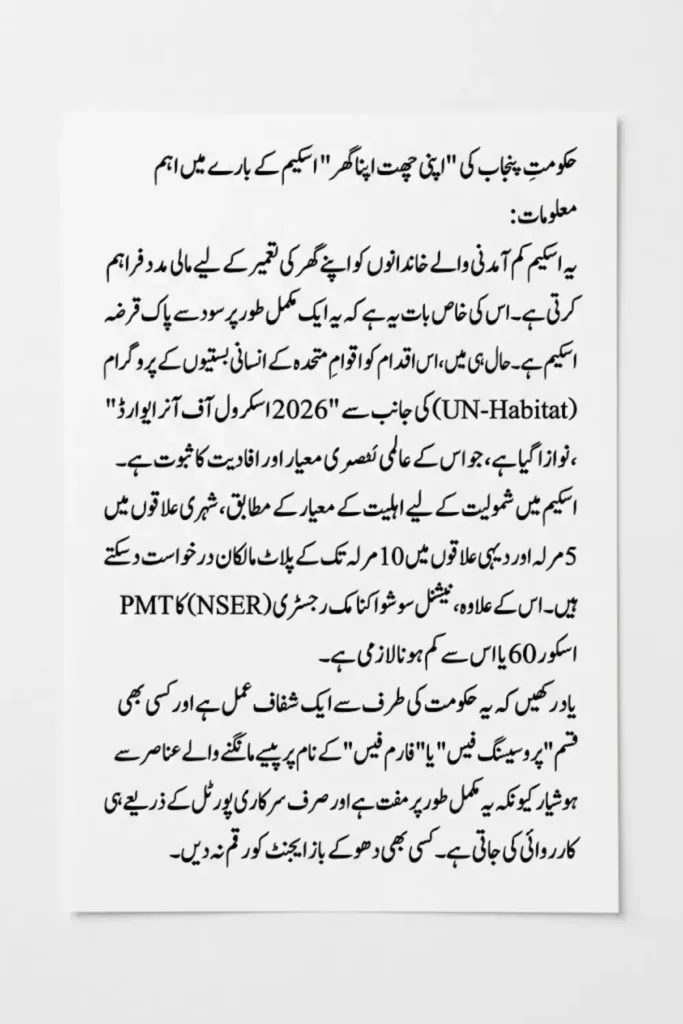
Now the program has caught the world’s attention. On October 5, 2026, UN-Habitat handed its 2026 Scroll of Honour Award to the Punjab Housing and Town Planning Agency (PHATA) in Muscat, Oman, as part of World Habitat Day events. The award recognises PHATA’s work in making safe and affordable housing available to low-income families.
It’s good news for the program, but one thing needs saying clearly: the award doesn’t open the door for everyone. You still have to meet the eligibility conditions like any other applicant.
So, what exactly is Apni Chhat Apna Ghar?
Think of it as a “build on your own land” scheme. It started in 2024 and is run by PHATA. It’s aimed at families who already own a small plot but can’t afford to construct a house on it.
Officially, the Punjab government’s broader goal is 100,000 affordable houses or apartments across the province, delivered through different models. The part most people talk about, though, is the interest-free financing for construction. The government isn’t handing out ready-made houses to every applicant. It’s helping eligible landowners build their own.
UN-Habitat described it in similar terms: a way for low-income families to build safe, dignified homes on land they already have. Applications go through a digital system, and money is released through participating financial institutions as the construction moves along.
Punjab Dhee Rani Program 2026 Phase 3: Rs200,000 Salami, Eligibility and Registration
Why did the UN notice it?
It wasn’t just because loans were being given out. UN-Habitat pointed to how the program combines public money, digital tools and accountability in day-to-day delivery.
This year’s awards drew 101 nominations from around the world, and only five winners were picked. PHATA was one of them, alongside recipients from Myanmar, Brazil, Tunisia and the United Kingdom.
Keep in mind what this is and isn’t. It’s recognition for how the program is run. It isn’t a new scheme, a new application category or a cash prize for individual applicants.
Who can apply?
According to the official Punjab portal, you need to tick the following boxes:
- You must be a permanent resident of Punjab as per your CNIC, and the head of your nuclear family in NADRA records.
- You must be the sole owner and possessor of the plot where you’ll build. It can be up to 5 marla in an urban area or up to 10 marla in a rural area, and it can be anywhere in Punjab.
- You must already own that land at the time you submit your online application.
- You must be registered in the National Socio-Economic Registry (NSER) with a household PMT score of 60 or below.
- You shouldn’t have certain criminal convictions, and you shouldn’t be a defaulter of any bank or financial institution.
There may be other checks too. Owning a plot is only the starting point, and your full application gets reviewed against all the rules.
How does the loan work?
The idea is simple: help an eligible family build a house on land it already owns, without charging interest.
According to UN-Habitat, the Bank of Punjab and partner microfinance institutions release the money in stages. Construction happens step by step, so it makes sense for funding to follow the same pattern rather than arriving as one lump sum.
As for exact amounts, repayment schedules and terms, please check them on the official portal. They can shift between phases. An earlier government announcement mentioned a Rs1.5 million loan with a monthly installment of roughly Rs14,000 over seven years, but that was an example from the past. Don’t treat it as the guaranteed deal today.
8171 Web Portal CNIC Check 2026: Check Your BISP Status Online
How to apply online
Before you start, double-check that your CNIC details, NADRA family record, land documents and NSER information are all correct. Mismatches are a common reason for delays.
Then the process looks like this:
- Go to the official Apni Chhat Apna Ghar portal.
- Create an account, or log in if you already have one.
- Fill in your personal and family details.
- Add information about the land you own.
- Upload the documents asked for.
- Submit the application through the online system.
- Wait for eligibility verification and follow the instructions you receive.
One warning: stay away from anyone, whether on a website, WhatsApp or a Facebook page, who asks for money to “process” your application or promises guaranteed approval. The official system doesn’t work that way.
How far has the program come?
Quite far, actually. Figures reported in September 2026 say over Rs260 billion has been disbursed for building more than 200,000 houses. That breaks down to roughly Rs196 billion for about 134,000 houses in the first phase, and around Rs62 billion for about 65,000 houses in the second.
Those numbers show the program’s scale, but they don’t change your personal situation. Past disbursements say nothing about whether you’ll be approved. Eligibility and verification still apply to every new applicant.
What sets it apart?
Most housing schemes ask families to buy a finished house. This one starts from a more realistic place: plenty of families already have a plot but no money to build. By funding construction directly, the program removes the biggest hurdle for them.
Technology plays a part too. In January 2026, the Punjab Information Technology Board signed an agreement with PHATA to develop and run a central digital platform for the program, with the aim of smoother applications, better monitoring and improved service. For people who would otherwise make repeated trips to government offices, that matters.
A quick note on the UN award confusion
Some people online seem to think the award brings extra benefits to applicants. It doesn’t. It’s not a separate loan and it doesn’t raise the amount anyone can get. UN-Habitat simply lists PHATA as one of its five 2026 Scroll of Honour recipients.
So if you see a post advertising a special “UN award registration,” ignore it. The normal eligibility rules and application process are the only route.
Punjab IT Internship Program 2026: Best Guide to Rs 50,000 Monthly Stipend
Frequently asked questions
Is the program still running in 2026?
Yes, it’s active, and its work has just earned the 2026 UN-Habitat Scroll of Honour.
Is the loan really interest-free?
Yes, according to official Punjab government and UN-Habitat information, eligible families receive interest-free financing for construction.
How much land do I need?
Up to 5 marla in urban areas or up to 10 marla in rural areas, and you must be the owner and possessor of that land.
What PMT score do I need?
An NSER household PMT score of 60 or lower.
Can I apply if I don’t own land?
Not under this program’s core criteria. You need to be the sole owner and possessor of a qualifying plot.
Did it really win a UN award?
Yes. PHATA received the 2026 UN-Habitat Scroll of Honour Award for expanding access to safe, adequate and affordable housing for low-income households.
Where do I get reliable updates?
Stick to the official Punjab government and Apni Chhat Apna Ghar channels, not random pages or third-party sites.
Final thoughts
Apni Chhat Apna Ghar has grown into one of Punjab’s biggest housing efforts, built around families who have land but lack the money to use it. Interest-free financing, a digital application process and a clear focus on affordability have now earned it international recognition, placing it among just five winners this year.
For the average applicant, though, one thing hasn’t changed: eligibility is what counts. Being a Punjab resident, owning a qualifying plot, meeting the NSER and PMT requirement and satisfying the remaining conditions is what decides the outcome.
If you’re planning to apply, read the latest official requirements first, and never pay anyone to “help” you get in. The official Punjab government portal is the safest place to confirm your eligibility and register.
FOR MORE INFO: Fake BISP Compliance Monitor Jobs: What You Need to Know Before You Apply