BISP Ever Married Condition Removed: What Changes for Unmarried Women

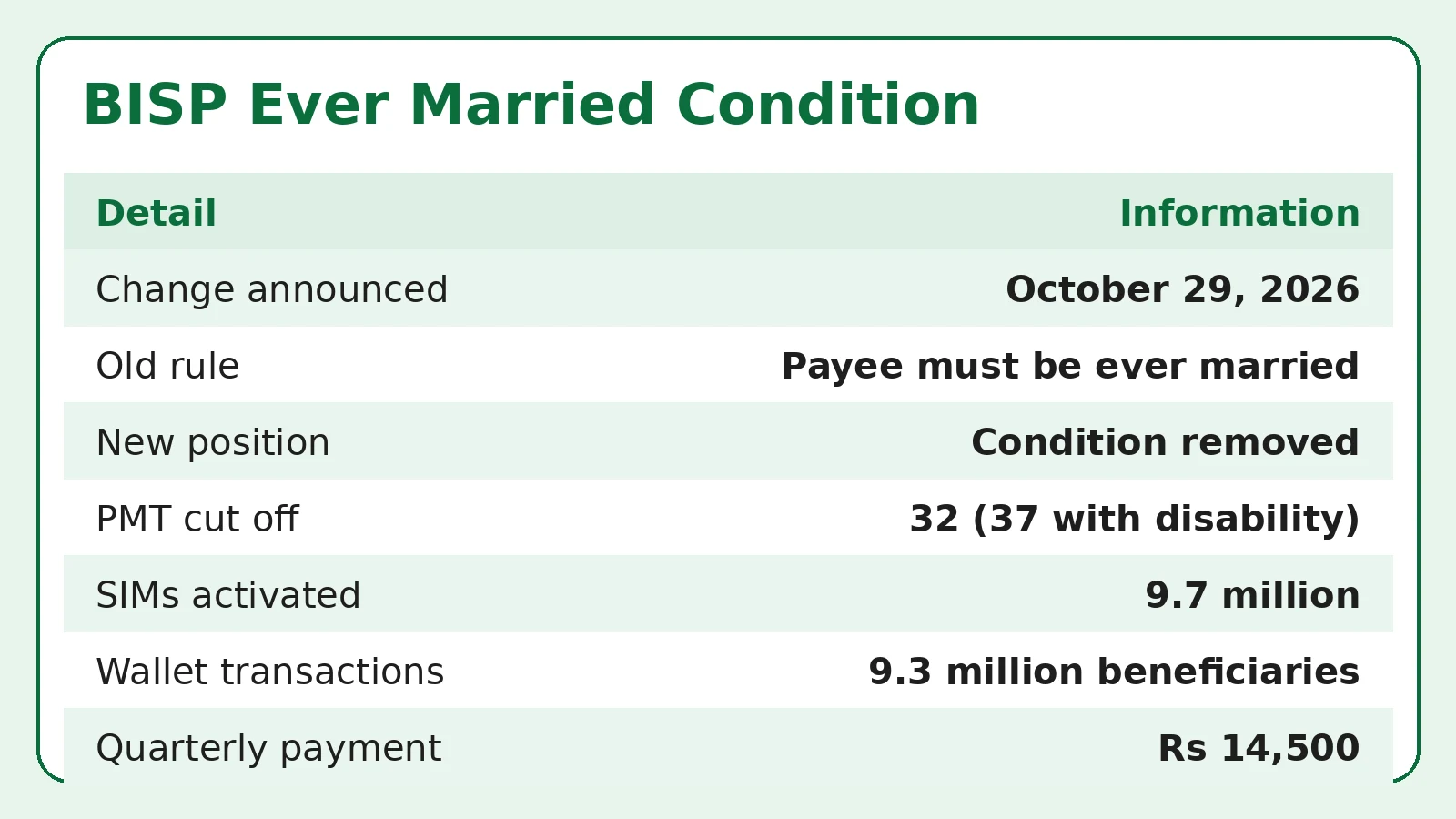
A quiet line in an official briefing last week could change who receives Benazir Kafaalat money in thousands of homes. The bisp ever married condition, the old rule that the woman receiving the payment had to be married or previously married, has been removed, officials told the First Lady during her visit to BISP headquarters on October 29. The Associated Press of Pakistan reported the briefing the same day.
This matters because the rule quietly shut out a real group of women. An unmarried adult daughter looking after elderly parents, or an elder sister raising her siblings, could not be named the payee for her household even when the family was poor enough to qualify. That door is now reported to be open.
BISP Ever Married Condition and What Was Announced
The bisp ever married condition came up during a briefing given to First Lady Bibi Asifa Bhutto Zardari at BISP headquarters in Islamabad. Chairperson Senator Rubina Khalid and Secretary Amer Ali Ahmad briefed her, and officials highlighted the removal of the ever married condition as a step to extend assistance to women previously excluded.
The same briefing shared the scale of BISP’s digital shift. Around 9.7 million Benazir SIMs have been activated, and 9.3 million beneficiaries have transacted through CNIC linked digital wallets under the Social Protection Wallet initiative. Our PMT score check guide explains the score behind eligibility.
The Old Rule and Who It Left Out
Until now, BISP’s own material described the Kafaalat payee as an ever married woman with a valid CNIC. In practice, that meant a poor household with no married woman in it could fall outside the programme altogether, however low its income was.
The change does not create a new payment or a new programme. It widens who can stand as the payee for an eligible household. For families headed by unmarried women, that is the difference between receiving Kafaalat support and receiving nothing at all.
What Has Not Changed: The Poverty Test
Removing the marriage condition does not remove the poverty test. A household still has to pass the survey based means test, with a PMT score at or below the cut off of 32, or 37 where a family member has a disability. Registration still happens in person through the survey, and the quarterly Kafaalat payment remains Rs 14,500 for the current quarter. The bisp ever married condition was about who could receive the money, not about how poor the household had to be.
It is equally important to say what BISP has not done yet. BISP has not published the formal notification, an effective date, or step by step instructions on its website. Until those appear, treat the removal as officially announced but still being put into practice. Our BISP 8171 web portal guide shows how to check your household status in the meantime.
What an Unmarried Woman Should Do Now
Start by checking the household record. Send the CNIC number by SMS to 8171 or enter it on the official 8171 web portal. If the household is surveyed and under the cut off, visit the nearest BISP Tehsil Office with the original CNIC and ask for the woman of the household to be recorded as the payee under the new position.
If the household has never been surveyed, ask the Tehsil Office about the dynamic survey, because eligibility is built on that record. And remember the standing warning: BISP messages come only from 8171, registration is free, and anyone demanding money to fix your record is running a scam. Report such people on the BISP helpline, 0800-26477.
Why This Change Matters for Poor Households
Social protection works when it follows real households, not textbook ones. Pakistan is full of homes where the responsible adult woman has never married: daughters caring for parents, aunts raising orphaned children, sisters holding a family together. A rule written for the typical family quietly punished these homes for their shape.
The removal of the bisp ever married condition will not change the payment amount, and it will not help a household that fails the poverty test. But for the families it does reach, it corrects an old unfairness. Until the notification is published, the Tehsil Office is the place where this change will first become real.
Official Source: Benazir Income Support Programme, official website
BISP Ever Married Condition FAQs
Has BISP removed the ever married condition?
Yes. Officials highlighted the removal during the First Lady’s briefing at BISP headquarters on October 29, 2026, reported by the Associated Press of Pakistan.
Who benefits from the removal of the ever married condition?
Unmarried women in poor households with no ever married woman, such as a daughter caring for elderly parents, can now be considered the household payee if the family passes the poverty test.
Has the poverty test for Kafaalat changed?
No. The poverty test is unchanged. A household still needs a PMT score at or below the cut off of 32, or 37 where a family member has a disability.
Has the Kafaalat payment amount changed with this rule?
No. The quarterly Kafaalat payment remains Rs 14,500, and the briefing announced no change to the amount.
What should an unmarried woman do to get recorded as the payee?
She should check the household status through the 8171 portal or by SMS, then visit the nearest BISP Tehsil Office with her original CNIC, because BISP has not yet published implementation instructions.