

8070 Ramzan Package 2026
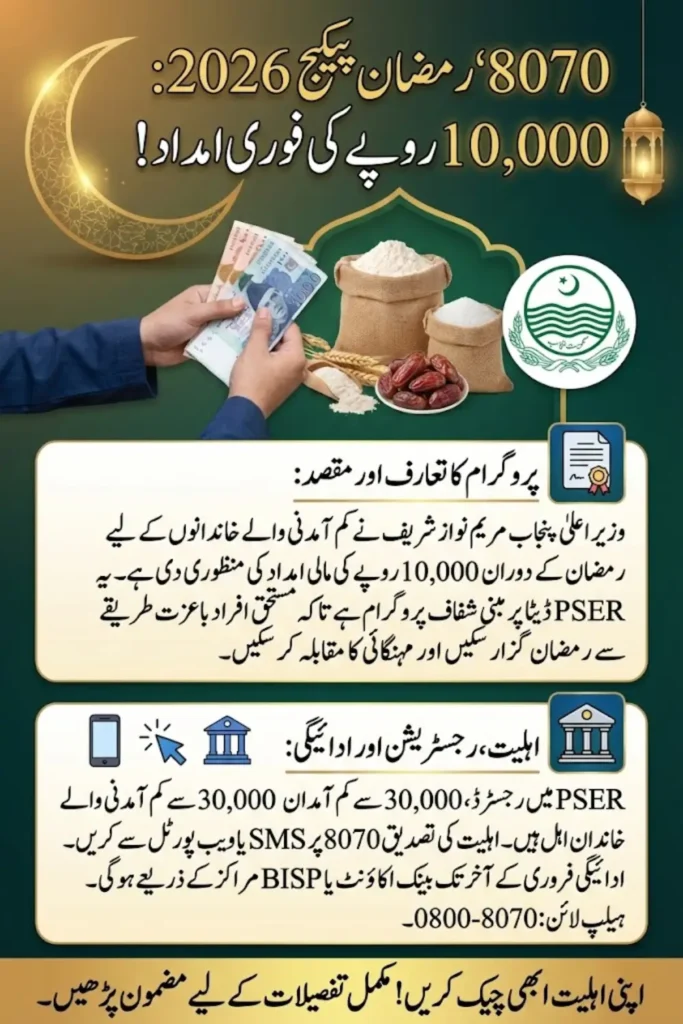
The 8070 Ramzan Package 2026 has been approved by the Chief Minister of Punjab, Maryam Nawaz Sharif, as part of a strategic initiative to provide financial relief to low-income families during the holy month of Ramadan. With prices of essential goods rising sharply every year during Ramadan, families often struggle to meet basic household needs. The Rs. 10,000 cash assistance provided under this program is designed to help households cover groceries, cooking essentials, and other necessities, ensuring that the holy month can be observed with dignity and security.
YOU CAN ALSO READ: How to Apply for the Russian Government Scholarship Pakistan: Full Guide for Bachelors, Masters & PhD (Deadline Jan 15 2026)
This initiative prioritizes transparency and fairness, relying heavily on the Punjab Socio-Economic Registry (PSER), a comprehensive database of families across the province. The PSER survey collects detailed socio-economic information, including family size, monthly income, housing ownership or rental details, education levels, access to healthcare, CNIC information for all adult members, ownership of assets such as vehicles or livestock, and utility bills. By registering through PSER, the government ensures that financial aid reaches families who truly need it, preventing duplication and misuse.
YOU CAN ALSO READ: CM Maryam Nawaz Officially Started Punjab Aghosh Program 2026: Registration, Eligibility, and Rs.38,000 Benefits
Eligibility Requirements for Receiving Rs. 10,000
Eligibility for the 8070 Ramzan Package is carefully structured to prioritize deserving families. To qualify, households must meet the following conditions:
- The family lives below the poverty line
- Possess a valid ration card
- Data registered in the PSER survey
- Monthly household income below Rs. 30,000
- No government employment or significant property
- Not currently receiving BISP benefits (though some cases may still qualify after verification)
Even families who are receiving other welfare programs may be eligible, as individual verification is conducted to ensure fairness.
How PSER Survey Works: Registration Methods
The PSER survey is the gateway to receiving financial assistance. Registration can be completed in two ways:
Door-to-Door Survey:
Government representatives visit homes to collect detailed family information. Applicants need to present their CNIC and electricity or rent receipts, provide details of all family members, and sign the survey form. A receipt with a token number is issued for future verification.
YOU CAN ALSO READ: Punjab Govt Announces Free Cows & Buffalos for Widows And Divorced Women By Livestock Program Phase 2; Here’s How To Apply?
Online Registration:
For areas not yet visited, families can complete the survey online through the official Punjab Government PSER portal. Users enter their CNIC and mobile number, fill in family details, answer questions about their economic status, submit the form, and save the reference number for verification.
How to Confirm Eligibility and Track Status
After registration, families can verify eligibility in two main ways:
- SMS Verification: Send your 13-digit CNIC to 8070. Responses are “Eligible,” “Not Eligible,” or “Under Review.”
- 8070 Web Portal: Expected to launch mid-February 2026, this portal will allow families to check approval status, monitor payments, update contact information, and download receipts.
This dual verification system ensures that every family can track their application status securely and transparently.
Payment Methods and Timeline
Cash assistance is distributed through two main channels to ensure ease of access:
Bank Account Transfers: Funds are deposited directly into registered bank accounts, with instant SMS notifications, providing a secure and convenient option.
BISP Payment Centers: Families without bank accounts can withdraw cash using their CNIC and biometric verification. Although there may be waiting times, this ensures secure delivery to all beneficiaries.
YOU CAN ALSO READ: Punjab 8070 Ramzan Relief Package 2026: How to Get Cash and Free Rashan Easily
Payment Schedule Table:
| Phase | Date | Description |
| Final Verification | 10th February | Eligibility confirmation |
| Payment Processing | 15th February | Funds prepared for disbursement |
| Disbursement | 20th February | Cash transferred to accounts or BISP centers |
| SMS Alerts | 20th February | Notification sent to beneficiaries |
Impact on Families: Real-Life Examples
The Rs. 10,000 assistance can transform household life for low-income families.
- Case 1: Imtiaz Bibi from Lahore, whose husband is a daily wage worker, can now afford flour, sugar, rice, lentils, cooking oil, meat, and dates for the month.
- Case 2: Muhammad Usman, a student in a six-member household, uses the funds to plan proper iftar meals and buy fruits that were previously unaffordable.
- Case 3: Saima, a widow raising three children in Faisalabad, can buy new clothes for her children for Eid while covering groceries, alleviating both financial and emotional stress.
These examples illustrate how the package ensures dignity, nutrition, and stability during Ramadan.
Maximizing the Benefits of Rs. 10,000
To make the most of the financial aid, families should prioritize essential groceries first, plan meals to reduce waste, and allocate some funds for minor household expenses or utilities. By doing so, households can manage their resources efficiently, covering both food and necessary household costs for the entire month.
YOU CAN ALSO READ: 8171 Registration Form Online Apply 2026: Complete Guide for Financial Assistance
Future of Transparent Welfare: 8070 Web Portal
The upcoming 8070 web portal represents a major step toward transparency and accountability in welfare distribution. Linked with PSER data, it allows families to instantly verify eligibility, track their assistance, and manage application-related concerns. This digitized system eliminates the need for intermediaries and ensures fair distribution across all districts in Punjab.
Common Challenges and Support Channels
Families may encounter issues such as CNIC errors, delayed verification, or website downtime. Solutions include rechecking CNIC entries, consulting the SMS service, and contacting official helpline support.
Support Information:
- Toll-Free Helpline: 0800-8070
- Email: info@pser.punjab.gov.pk
- Hours: Monday to Friday, 9 AM to 5 PM
Families are reminded to use only official channels and avoid any agent or middleman fees to prevent scams.
Conclusion:
The 8070 Ramzan Package 2026 is more than financial assistance; it is a program that ensures families can celebrate Ramadan with dignity, nutrition, and peace of mind. Through PSER registration, SMS verification, and the upcoming web portal, the program delivers aid transparently and efficiently, reaching those who need it most. Families are encouraged to register promptly, check their status regularly, and make effective use of the support to improve their household well-being during the holy month.
8070 Online Registration 2026: Step-by-Step Method
Getting registered for the 8070 Ramzan Package is simpler than most people expect. There is no long form to fill on a random website. Registration flows through the PSER survey system, and here is how it works in practice.
First, check whether your household is already part of the PSER database. Government survey teams visited homes across Punjab to collect family details. If your family was surveyed, your data is already in the system. If your area was missed, you can complete the survey online through the official Punjab government portal.
Once your PSER record exists, the 8070 check is just an SMS away. Type your 13-digit CNIC number and send it to 8070. You will get a reply telling you whether you are eligible. That is the entire process. No agents, no fees, no office visits.
Rs 10,000 Cash Details: Amount, Payment Method and Timeline
The headline figure is Rs 10,000 per eligible family. This is a one-time cash grant for Ramadan 2026, meant to cover essential kitchen expenses during the holy month. It is separate from regular BISP installments.
Payments go out through two channels. If you have a registered bank account, the money lands there directly with an SMS alert on your phone. If you do not have a bank account, you can collect the cash from a BISP payment center after biometric verification with your original CNIC.
8070 Muft Atta and Rashan Sub-Program
Alongside the cash grant, the 8070 program connects families with free flour (muft atta) and ration support. This part of the scheme targets the same PSER-verified households. Distribution happens through designated utility stores and distribution points announced by the district administration.
If you received the eligibility confirmation SMS from 8070, ask at your nearest distribution point about the atta and rashan schedule for your area. Timings vary by district, so the helpline 0800-8070 is the fastest way to confirm.
8070 Portal: Check Your CNIC Status via SMS
The 8070 SMS service is the backbone of this program. To check your status, open your phone’s messaging app, type your 13-digit CNIC number without dashes or spaces, and send it to 8070. You should receive one of three replies: Eligible, Not Eligible, or Under Review.
If you see Under Review, your record is still being matched against NADRA and PSER data. Wait a few days and check again. If the reply says Not Eligible, make sure your CNIC is valid and your family details are updated in NADRA records.
PSER Survey and Its Role in the 8070 Program
PSER stands for the Punjab Socio-Economic Registry. Think of it as the master list the Punjab government uses to decide who qualifies for relief programs. The 8070 Ramzan Package pulls its beneficiary list directly from PSER, which is why the survey matters so much.
If your household never completed the PSER survey, the 8070 system may not find your record. Completing the survey, either when teams visit or online, is the single most important step. Without a PSER record, even a deserving family can be missed.
Nigehban Program: How It Relates to 8070
You may have heard the name Nigehban Ramzan Package. This is the same Punjab government relief effort, announced by Chief Minister Maryam Nawaz. Nigehban is the program name; 8070 is the SMS code used to check eligibility for it. They are two names for one initiative.
Under the Nigehban umbrella, the province set an income ceiling so that support reaches the right households, and linked the package with the Rs 10,000 Rashan Card for ongoing monthly relief. When you read about Nigehban, know that the 8070 check is how you confirm your place in it.
8070 vs 9999: Understanding the Two Relief Codes
This is where many families get confused, so let us clear it up. 8070 is the Punjab government’s code for its Rs 10,000 Ramzan relief, known as the Nigehban program. 9999 is the federal government’s code for its Rs 13,000 Ramzan relief, known as the Prime Minister’s package.
The two programs are separate. 8070 is run by Punjab and verified through PSER. 9999 is run by the federal government and verified through NADRA records. You send your CNIC to 8070 to check the Punjab package, and to 9999 to check the federal package. Eligibility is decided independently by each program’s database.
Frequently Asked Questions (FAQs)
What is the 8070 Ramzan Package 2026?
It is the Punjab government’s Ramadan relief initiative providing Rs 10,000 cash assistance to eligible low-income families, verified through the 8070 SMS service.
How do I check my eligibility for the 8070 package?
Send your 13-digit CNIC number via SMS to 8070. You will receive a reply with your eligibility status.
Is there any fee for the 8070 SMS check?
The check itself is free, though your mobile operator may apply standard SMS charges. Never pay anyone who claims they can get you approved.
What is the difference between 8070 and 9999?
8070 is Punjab’s Rs 10,000 relief code. 9999 is the federal government’s Rs 13,000 relief code. They are separate programs.
Do I need the PSER survey to qualify?
Yes. The beneficiary list is drawn from the Punjab Socio-Economic Registry, so completing the PSER survey is essential.
Where do I collect the Rs 10,000?
Through a bank transfer to your registered account, or in cash from a BISP payment center after biometric verification.
YOU CAN ALSO READ: Tracking Gold in Pakistan 2026: Live Rates Purity Tips, and Smart Investment Advice
[…] so anyone asking you to pay for enrolment is lying. Seasonal support works differently, as our 8070 Ramzan Package guide explains, and registered workers get monthly help through the Maryam Nawaz Ration Card. This atta […]